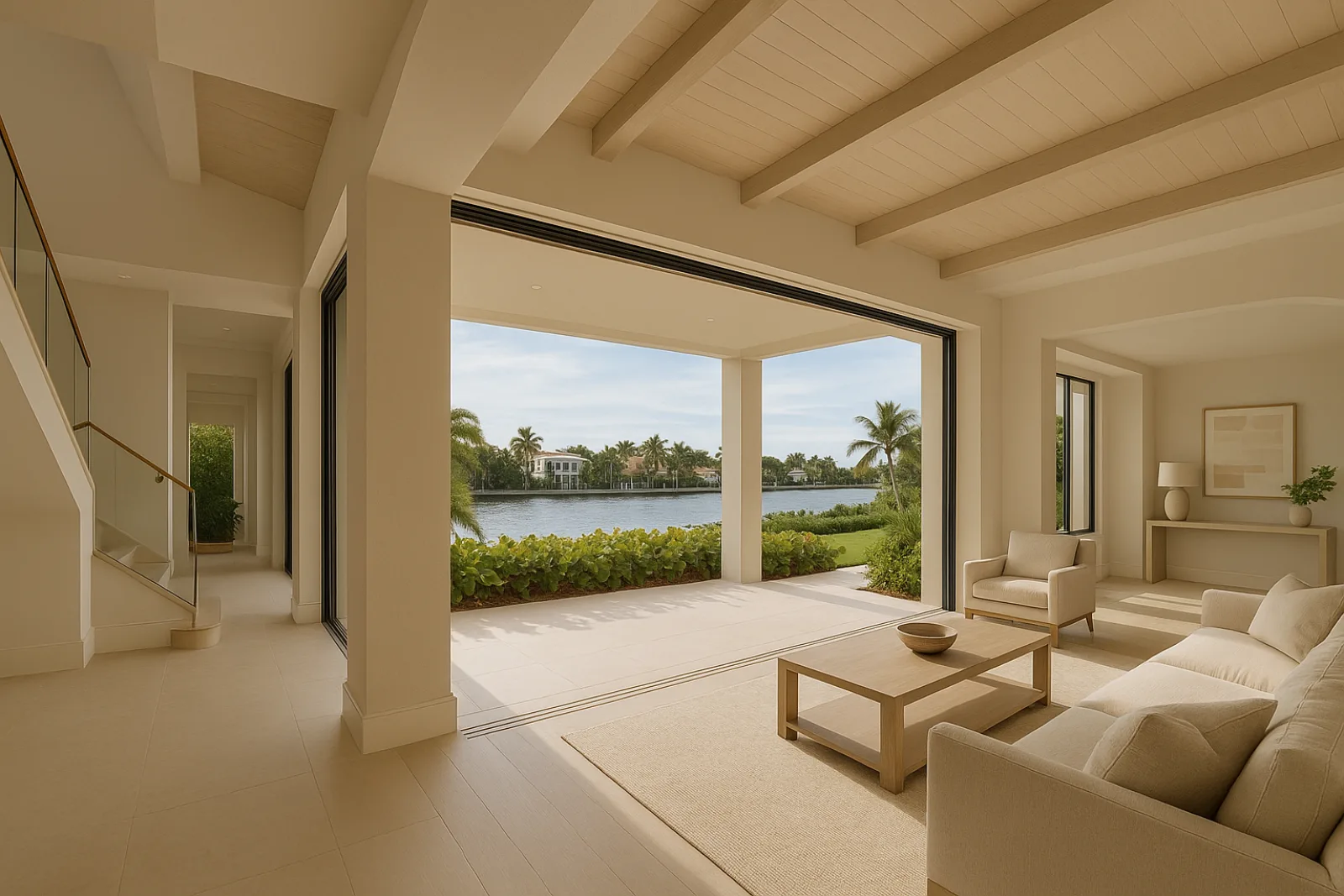
A Barrier Island of Custom Single-Family Homes
Ocean Ridge is almost entirely custom single-family construction on generous lots, a different pattern from the condo towers that dominate much of this stretch of coast. Inlet Cay's canal-front parcels, Ocean Ridge Yacht Club and Crown Colony each carry their own lot geometry and water access, but none of them share a dominant architectural style the way a district with historic zoning would.
That lot-by-lot variety means design here starts from the site rather than from a townwide pattern book — dune proximity, canal frontage and lot orientation to the barrier island's long axis shape a design more than any single architectural vocabulary does. A house on Inlet Cay's protected canal answers to different site conditions than one facing open ocean.
Coastal Construction Control Line Rules
Any construction seaward of Florida's coastal construction control line, which runs through much of Ocean Ridge's oceanfront property, needs a permit from the state's environmental agency in addition to standard county and town permitting. That review covers structural design for wave and erosion forces, not just the building code baseline that applies further inland.
Dune protection adds another layer for oceanfront lots specifically, restricting grading, vegetation removal and where structures can sit relative to the dune line. A project on a canal-front Inlet Cay lot generally doesn't trigger CCCL review, but anything facing the open Atlantic almost certainly will, which changes both the permitting timeline and the structural engineering involved.
Renovation, Additions and Custom Homes in Ocean Ridge
RENOVA works across the full range of residential scope on the island, from a single remodeled bathroom to a ground-up custom house on a cleared oceanfront lot. Given the size of most Ocean Ridge parcels, additions and whole-home renovations come up nearly as often as new construction, since there's usually room to expand rather than rebuild.
Waterfront work carries its own considerations regardless of project type — dock and seawall coordination on canal lots, dune-line setbacks on oceanfront parcels — that a purely inland renovation elsewhere in the county wouldn't need to account for at all, even on a comparably sized lot.
- Kitchen remodeling
- Bathroom remodeling
- Whole-home renovation
- Custom home construction
- Design-build project delivery
- Construction management
Materials for Direct Ocean Exposure
Salt exposure on Ocean Ridge is more direct and more constant than on inland or intracoastal-only properties, since much of the town sits within a few hundred feet of open surf. Impact glazing, stainless and marine-grade hardware, and coastal-rated finishes are the baseline specification here rather than an upgrade, particularly on oceanfront and near-dune lots.
Flood elevation requirements from current FEMA mapping apply to any project touching the foundation, and on a barrier island that typically means a meaningfully higher finished floor than older construction on the same lot was built to. HVAC systems are sized for both humidity and the added load of a more exposed building envelope.
Sequencing Around Sea-Turtle Season
From March through October, Ocean Ridge enforces sea-turtle lighting restrictions on properties near the beach, requiring exterior fixtures to be shielded, low-mounted and amber-spectrum rather than standard white light visible from the sand. Any exterior lighting installation or fixture testing on an oceanfront or near-oceanfront lot has to work within that seasonal window.
That restriction shapes scheduling more than most homeowners expect — a project that needs final exterior lighting inspection during turtle season may need temporary shielding or a phased approach, while work planned for completion outside the March-to-October window has more flexibility on fixture testing and final adjustment.
What Drives Cost Here
Coastal construction control line review adds both time and structural engineering cost to any oceanfront project, since the state's review covers wave and erosion forces beyond standard building code requirements. Foundation elevation and dune-compliant siting are the other major site-specific cost factors that vary significantly by lot.
Turtle-compliant exterior lighting fixtures cost more than standard exterior fixtures, and sequencing work around the seasonal restriction can add schedule length on oceanfront projects with significant lighting scope. Waterfront lots, whether canal or ocean-facing, also carry seawall, dock and dune-line coordination that inland projects elsewhere in the county don't.
- Coastal construction control line permitting and engineering
- Foundation elevation for barrier island conditions
- Turtle-compliant exterior lighting fixtures
- Seawall, dock and dune-line coordination
- Marine-grade hardware and finishes
Living Through Construction on the Island
Ocean Ridge's single-family lot sizes give more room for staging and material storage than a tighter urban site would, which makes occupied renovations more manageable here than in denser parts of the county. Even so, barrier island access is limited to a small number of crossings, so delivery timing accounts for that constraint.
For occupied renovations, phased scheduling keeps part of the house livable while work moves through in sequence. Homeowners who relocate during heavier structural or mechanical phases typically return once framing, rough-in and drywall are complete, with finish work proceeding around a household back in residence.
Starting a Project in Ocean Ridge
The first step is a site visit to determine whether the lot falls seaward of the coastal construction control line and what that means for permitting, alongside a look at current flood elevation requirements for the property. That early read shapes the realistic scope and schedule before design work begins.
From there, design development moves in parallel with a preliminary budget so the project's scope and any CCCL or turtle-season sequencing stay aligned before drawings are finalized. Past work such as Harbor Point and the South Ocean Blvd project reflects the range RENOVA has delivered along this stretch of coast.
Common questions
No. CCCL review applies to construction seaward of the control line, which mainly affects oceanfront lots. Canal-front and inland properties on the island typically go through standard county and town permitting without that additional state review.
From March through October, exterior lighting visible from the beach on Ocean Ridge properties near the shore must be shielded, low-mounted and amber-spectrum rather than standard white light, to avoid disorienting nesting sea turtles and hatchlings.
Yes, but final fixtures and testing need to meet the shielding and amber-spectrum requirements throughout the season on qualifying properties. Projects with significant exterior lighting scope sometimes sequence final lighting work outside the March-to-October window for more flexibility.
Ocean Ridge is reached by a limited number of bridges and causeways, so material deliveries and equipment access are planned around that constraint, particularly for larger items like structural steel or crane deliveries that need advance coordination.
Generally yes. Canal-front lots typically don't trigger coastal construction control line review the way oceanfront parcels do, though they carry their own seawall and dock considerations that an oceanfront project wouldn't need to address.
Current FEMA mapping typically calls for a higher finished floor elevation on barrier island properties than comparable inland sites, which affects foundation design on any project touching the existing foundation or building new.